Hidden in Plain Sight: Industrial AI

Solutions Where You Never Thought to Look
Compiled by Talia Reynolds
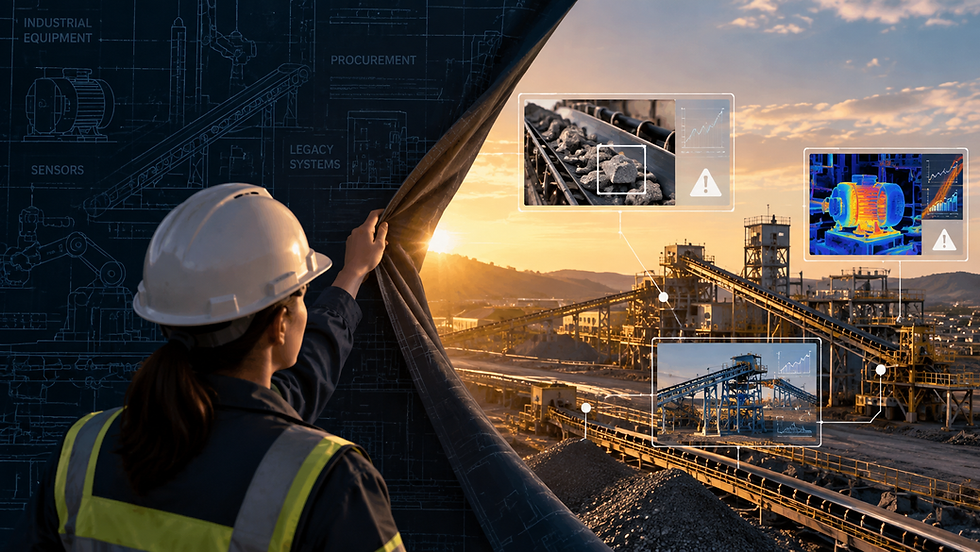
When people think about enterprise AI today, they often picture tools that live on a screen: copilots helping employees draft emails, agents processing documents, or chatbots answering internal questions.
For industrial companies, some of the most valuable applications look very different. They may involve a camera identifying a defect before a product leaves the line, a sensor detecting subtle changes in equipment behavior before a failure occurs, or a system interpreting imperfect field data quickly enough for an operator to make a better decision.
Israeli company Razor Labs, for example, combines data from multiple industrial sensors and visual monitoring systems to help mining operators detect equipment failures earlier and understand their root causes. In other cases, AI may sit inside autonomous equipment operating in environments where connectivity is inconsistent and mistakes carry real operational or safety consequences.
The next wave of industrial AI is likely to be shaped less by advances in conversational interfaces and more by systems that can reliably interpret, respond to, and operate within the physical world.
AI Gets Harder When It Leaves the Screen
Industrial environments introduce complications that most digital workflows do not. Data may come from several generations of equipment, sensors can behave differently under heat, dust, vibration, or changing weather conditions, connectivity may be inconsistent, and legacy systems still need to communicate with newer technologies.
Even a model that performs extremely well in a controlled setting can have limited value if its outputs are unreliable, difficult to interpret, or impossible for operators to trust on the factory floor.
The National Institute of Standards and Technology’s (NIST) 2026 roadmap for AI in smart manufacturing highlights many of these same challenges, including complex industrial data, integration with heterogeneous sensing and control systems, and the need for AI systems that remain reliable and trustworthy in high-stakes operating environments.
In that setting, intelligence alone is not enough. The real challenge is combining perception, context, and reliable execution under real-world operating conditions.
That distinction matters because it changes where industrial companies should be looking for AI in the first place.
Looking for AI in the Physical World
A 2026 mapping by Israeli venture firm 10D identified 125 Israeli companies working in physical AI, with more than $10 billion raised across the group. More interesting than the headline figure, however, is the underlying concentration of technologies in areas such as sensing, computer vision, autonomous systems, mobility, and technologies designed to interpret physical environments.
That capability did not emerge with the current AI boom. Israel has spent decades building technologies around perception, signal processing, mobility, defense, and autonomous systems, many of which were developed for environments where data is incomplete, conditions are unpredictable, and systems are expected to make decisions under pressure.
Increasingly, those capabilities can be applied far beyond the markets they were originally built to serve.
A computer vision technology developed for security may be useful in industrial inspection. A perception system built for mobility could have applications in mining or logistics. A sensing technology designed for one operating environment may solve a completely different problem inside a factory, utility, or infrastructure network.
And this is where things become particularly interesting for corporate buyers.
The Best Solution May Be Hiding in the Wrong Category
Companies naturally search within the categories they know.
A manufacturing team facing an inspection problem will usually look for industrial inspection technologies. A utility trying to improve asset monitoring will search for energy or infrastructure solutions. A mining company may focus on vendors already serving mining.
That approach makes sense, but it can also create blind spots.
A construction-industry client approached Axis looking for a robotic solution to address autonomous navigation in challenging environmental conditions. During the search, Axis identified RGo Robotics, whose perception technology was already being used in warehouse and mobile-robotics applications. Although the company did not initially appear to be an obvious construction-tech fit, the same computer-vision, mapping and navigation capabilities could be applied to outdoor machinery operating in complex construction environments.
This kind of example gets to the heart of the opportunity. The relevant technology may already exist, but it may be sitting in a category the buyer would never have thought to search.
Traditional industrial companies generally understand their own technology landscape extremely well. What they cannot reasonably be expected to do is track every adjacent startup ecosystem, identify technologies developed for unrelated sectors, and determine which of those capabilities can translate into their own operations.
That is where technology scouting becomes more than a database exercise.
Looking Beyond the Label
For industrial buyers, that means the most relevant solution may come from a company that does not market itself as an industrial technology provider at all, and in some cases may not even lead with AI as part of its identity.
What matters is whether the underlying technology can solve the operational problem better than the options already visible inside the buyer's usual search universe.
At Axis, that is increasingly how we approach technology scouting: start with the problem, understand the capabilities required to solve it, and then search across sectors rather than staying confined to a single industry label.
Because sometimes the best answer is not sitting in the category you started with.
Sources: National Institute of Standards and Technology, "2026 Roadmap on Artificial Intelligence and Machine Learning for Smart Manufacturing"; 10D, "Israeli Physical AI Map" (2026); CTech, "125 companies, over $10 billion raised: Mapping Israel's Physical AI ecosystem."


